
SEO, GEO, and AEO for Squarespace Websites: What They Are and Why You Need All Three
SquareSPACE SEO
SEO, GEO, and AEO for Squarespace Websites: What They Are and Why You Need All Three
If you've built your business on Squarespace, you've probably heard the term SEO more times than you can count. But lately you're also hearing local SEO, GEO, and AEO thrown around — and if you're not sure whether those are different strategies or just different ways of saying the same thing, you're not alone.
Here's the short answer: SEO gets you found on Google. Local SEO gets you found by people near you. GEO gets your business described and recommended accurately by the AI models people increasingly turn to first. AEO gets specific pieces of your content directly quoted and cited inside AI-generated answers. They're related but not interchangeable, and a Squarespace website that only addresses one of the four leaves visibility on the table.
This guide breaks down what each one actually means, how they work together on a Squarespace site specifically, and what to prioritize first based on the kind of business you run.
What is technical SEO?
SEO (Search Engine Optimization) is the process of improving a website's health so it ranks higher in organic search results. It covers technical elements, site structure, content, and keywords — all the pieces that help Google understand your site and decide it's worth showing.
On a Squarespace site, the core SEO fundamentals come down to:
SEO titles that include your primary keyword and sit between 50–60 characters
SEO descriptions between 150–160 characters that read like an ad for the page
A single H1 per page containing your target keyword. Think of it like the title of a document. Setting more than H1 on a page can create hidden hierarchy issues if you're not checking.
Compressed images with keyword-relevant alt text . Aim for images to be around 250 to 500 kb. Oversized images and blank alt tags are two of the most common technical issues we see on Squarespace audits. Squarespace now has a handy “SEO / AI Visibility” tab that allows you to quickly identify images that are missing alt text. It will even generate AI suggested alt text for you.
Clean, keyword-rich URL slugs, with a 301 redirect plan if you're changing an existing one
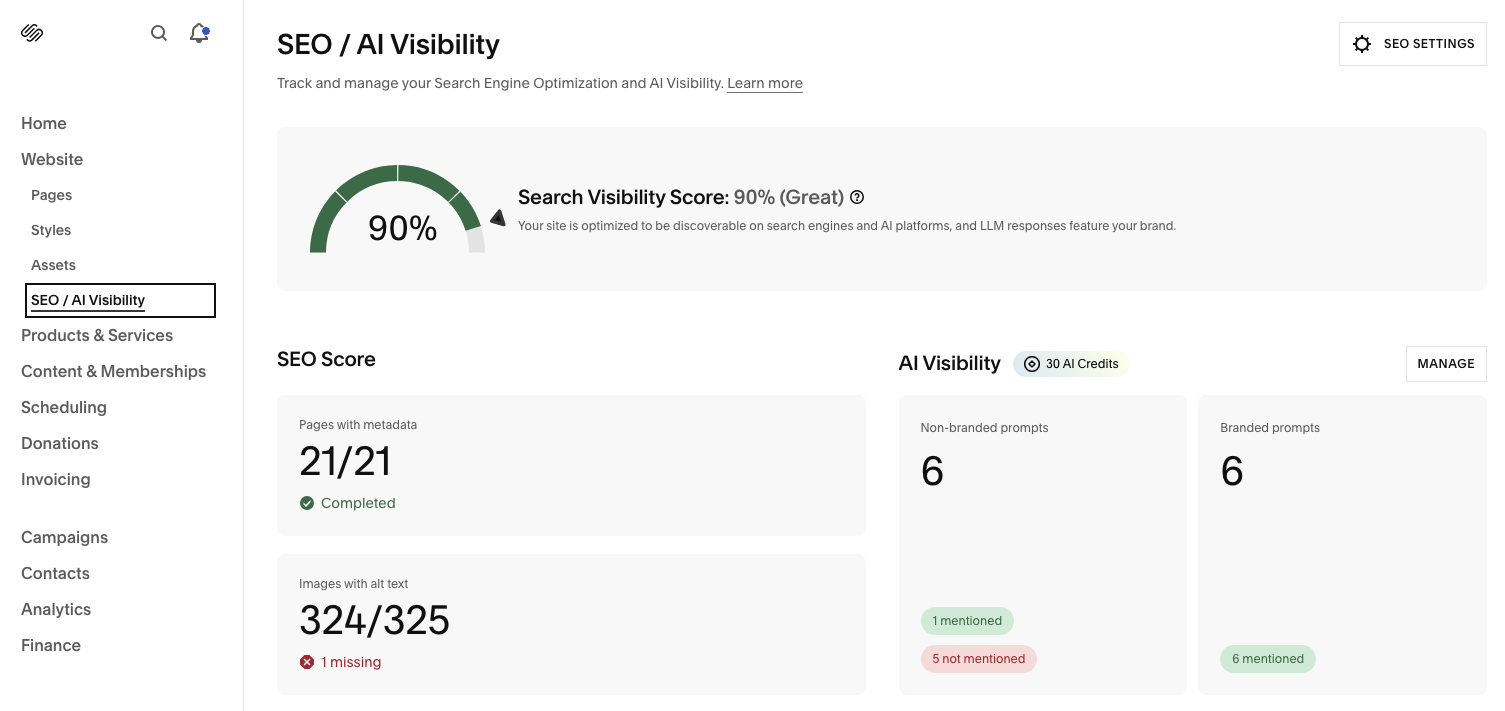
Squarespace SEO / AI Visibility Tab
A surprisingly common pattern we see is Squarespace sites with a decent number of referring domains and a healthy backlink profile, but have zero ranking keywords. That's rarely a link problem — it's a content problem. Having a keyword strategy is super important if you want to compete in non-branded organic search results.
What is Local SEO?
Local SEO is about ranking in location-based searches — the results people see when they search "[service] near me" or "[service] in [city]." If SEO is about being found generally, local SEO is about being found by the people closest to you and most likely to book.
Google decides local ranking using three factors, sometimes called the local ranking triangle:
Relevance: does your business offer what the searcher is looking for?
Distance: how close are you to the searcher?
Prominence: how well-known and trusted is your business online?
You can influence all three through your website and your Google Business Profile (GBP). GBP is arguably the single most important local ranking lever available to a small business — a strong website with a weak GBP underperforms, and a strong GBP pointing to a generic homepage underperforms too. Both need to work together.
Practical local SEO strategies for a Squarespace site:
Dedicated neighbourhood or service-area pages. One page per area you actively serve, not one generic "service areas" paragraph buried on your homepage. These pages rank faster than broad city-wide pages because competition is lower and relevance is higher.
A fully built-out GBP. Primary and secondary categories, service list, complete business info using your keywords, and service areas that match what's actually on your site.
Service Area Business (SAB) configuration. If you don't have a public storefront like me, listing service areas instead of a fixed address removes a distance penalty that trips up a lot of home-based and mobile service businesses.
Reviews that mention neighbourhood, service, and outcome naturally. A review that says "she redesigned our kitchen in East York and the process was seamless" carries far more local ranking weight than a five-star rating with no detail.
Need help updating your website to improve its technical and local SEO? Our Squarespace web design & development services include these fundamentals from day one, so you're not retrofitting SEO onto your site later.
What is GEO?
GEO (Generative Engine Optimization) is about shaping how AI models describe, recommend, and reference your business when they're forming an answer — not just whether one specific page of yours gets quoted, but whether the broader web gives generative models an accurate, consistent picture of who you are. It's a wider, slower-moving discipline than AEO: less about structuring one FAQ block to be lifted verbatim, more about making sure everything AI models can see about your business — your site, your directory listings, your press mentions, your social profiles — tells the same coherent story.
Where AEO is tactical (structure this page so it gets cited), GEO is about your overall presence across the web that AI models draw on to form an opinion of your business in the first place.
Practical GEO moves for a Squarespace site:
Consistent business description everywhere you appear. Your Squarespace site, Google Business Profile, industry directories, and social bios should describe your service, location, and specialty in matching language, not four slightly different versions.
Third-party mentions and citations. Press features, industry roundups, guest posts, and directory listings function as the GEO equivalent of backlinks. AI models weigh what other sources say about you, not just what you say about yourself
Structured data (Organization schema). Custom code on your site that clearly ties your name, services, and location together as one identifiable entity.
Auditing what AI tools currently say about you. Periodically ask ChatGPT, Perplexity, or Google AI Overviews questions like "best [service] in [city]" to see whether your business shows up, and if it does, whether the description is accurate.
What is AEO?
AEO (Answer Engine Optimization) is the newest of the four, and it's about being cited by AI search tools — ChatGPT, Perplexity, Claude, and Google's AI Overviews. Unlike a traditional Google results page, these tools don't hand the searcher ten blue links. They read across the web and hand back a summarized answer, often with a source or two cited by name. Where GEO is about your overall reputation across the web, AEO is the tactical work of structuring individual pages so they're the ones that get lifted into that summarized answer.
AI engines tend to pull from content that is specific, well-structured, and easy to lift as a direct answer. Two examples of the same fact, one AEO-friendly and one not:
✗ "When it comes to interior design, there are many factors to consider, and the market has changed a lot over the past decade."
✓ "Interior design in Toronto typically costs between $150 and $500+ per hour, depending on scope, experience, and whether the engagement is full-service or consulting."
The second version answers the question in the first sentence, with a real number and real context. That's what gets pulled into an AI Overview or a ChatGPT response — the first version just gets skipped.
A few things that consistently move the needle on AEO:
A structured FAQ section at the end of every blog post and service page, that uses natural question phrasing as the heading itself ("How much does interior design cost in Toronto?" rather than "Pricing").
FAQ schema markup (JSON-LD, added through Squarespace's Code Injection field) so search engines can identify your Q&A content as exactly that — this doesn't come built into Squarespace and has to be added manually per page to the page header code.
Entity consistency using the same primary term for your service across every page. A business that calls itself a "sleep consultant" on one page and a "sleep coach" on another is diluting how confidently Google & AI tools can identify it as a single, coherent authority.
Checking where you're already ranking but losing the click to a featured snippet — sometimes the fix isn't new content; it's restructuring existing content so you become the snippet instead of losing traffic to one.
How SEO, GEO, & AEO Work Together
None of these four operate in isolation. A neighbourhood page (local SEO) still needs a clean SEO title and H1 (SEO). A blog post built for topical authority (SEO) is far more likely to get pulled into an AI Overview if it closes with a well-structured FAQ (AEO) — and it's more likely to be trusted as a source in the first place if your business is described consistently everywhere else on the web (GEO). Trying to run one without the others is a bit like optimizing only the front door of a house and ignoring the windows and the roof.
That said, priority isn't identical for every business. As a general rule:
| Business type | SEO priority | Local SEO priority | GEO priority | AEO priority |
|---|---|---|---|---|
| Local service, single location | High | Very High | Medium | Medium–High |
| Regional service, multiple cities | High | High (per city) | Medium–High | High |
| E-commerce | High | Low | Medium | Medium |
| Content or media | High | Low | High | High |
For most local service businesses on Squarespace, the order that compounds fastest is local SEO → SEO → AEO → GEO. Getting local visibility right tends to lift everything else with it, because local relevance and prominence signals feed directly into how confidently Google treats your site as an authority — GEO's broader entity-building work pays off over a longer horizon and matters most once the fundamentals are already in place.
Where to Start
If you're auditing your own Squarespace site for the first time, start with the technical basics — titles, descriptions, H1s, image compression, alt text — because these are quick wins that don't require new content. From there, build out one dedicated page per service area you actually serve, make sure your Google Business Profile matches your website, and close out your existing blog posts and service pages with a real FAQ section instead of leaving them to end abruptly.
None of this needs to happen all at once. A phased approach — foundational fixes in month one, your first neighbourhood and service pages in months two and three, then a steady blog cadence from month four onward — is realistic for almost any business size, and it's the same order that tends to produce the fastest visible movement in rankings.
If you'd rather have someone audit exactly where your site stands across all four areas — technical health, local visibility, AI-model reputation, and answer-engine readiness — that's exactly the kind of audit we run for Squarespace businesses.
Frequently Asked Questions
Is GEO the same thing as local SEO?
No — this is a common mix-up. GEO stands for Generative Engine Optimization, and it's about shaping how AI models describe and recommend your business across the web. Local SEO is the discipline that covers ranking in location-based searches like "[service] near me." They're both worth doing, but they're not interchangeable, and some sources use "GEO" to mean the local/geographic discipline instead — so it's worth checking which definition a source is using.
What's the difference between GEO and AEO?
GEO is broader and slower-moving: it's about your overall reputation and consistency across the web that AI models draw on when forming an answer about your business. AEO is tactical: it's the work of structuring a specific page or FAQ so it's the exact piece of content an AI tool lifts into its response. Strong GEO makes your business more likely to be considered at all; strong AEO makes a specific page more likely to be the one that gets cited.
Does Squarespace have built-in schema markup?
Squarespace automatically generates basic Organization or LocalBusiness schema when your Business Information panel is filled out, but it does not have a built-in generator for FAQ, Service, or Review schema. Those require manually adding JSON-LD code through the page's Code Injection field.
How long does it take to see results from local SEO?
Neighbourhood-specific pages generally rank faster than broad, city-wide pages because there's less competition, and business owners often see movement within a few months of publishing a well-built page alongside an optimized Google Business Profile.
What should I put in an FAQ section for AEO?
Use natural question phrasing that mirrors how someone would actually ask an AI tool or type into Google, and answer directly in the first sentence with specific numbers, timelines, or local context wherever possible. Five to eight questions per post is a solid target.
Can a website have zero ranking keywords even with good backlinks?
Yes. A site with a healthy referring domain profile but no ranking keywords almost always has a content or on-page optimization problem, not a link problem. The fix is usually rewriting titles, descriptions, and body copy around the right keywords rather than building more links.
Do I need a physical address listed for local SEO to work?
Not necessarily. If you're a home-based or mobile service business without a public storefront, configuring your Google Business Profile as a Service Area Business and listing your service areas instead of a fixed address can remove a distance penalty and often works better than an unused office address.
What's the difference between AEO and traditional SEO?
Traditional SEO aims to rank in a list of links; AEO aims to be the summarized answer or cited source inside an AI-generated response. The underlying content quality matters for both, but AEO puts more weight on direct, specific answers and clear question-based structure.

Marlo Biasutti, RGD
CEO/Creative Director
Follow us on social media